
There are moments in this work when something shifts—from planning and persistence to real, visible progress.
This is one of those moments.
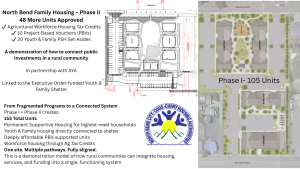
North Bend Family Housing Phase II has been approved.
And with it, something bigger comes into focus—not just another development, but a fully connected system of housing on the South Coast.
What Phase II Brings
Phase II builds directly on the foundation created in Phase I and expands what’s possible on this site:
- Agricultural Workforce Housing Tax Credits
- 10 Project-Based Vouchers (PBVs)
- 20 Youth & Family Permanent Supportive Housing (PSH) Set-Asides
These aren’t just funding sources or unit counts—they represent intentional alignment.
This phase is designed to serve youth and families who are exiting homelessness, with housing that is directly connected to services and long-term stability.
Connecting Shelter to Housing
One of the most important pieces of Phase II is its direct connection to the Executive Order-funded Youth & Family Shelter.
Through this alignment, youth and families won’t just access temporary shelter—they will have a clear pathway into permanent housing.
That connection is what turns programs into a system.
And it wouldn’t be possible without strong partners.
A special thank you to AYA, who will be serving these households and helping ensure that youth and families are supported every step of the way—from crisis to stability.
What This Means for the Full Site
With both Phase I and Phase II moving forward, North Bend Family Housing becomes something rare—especially in a rural community:
A fully integrated housing continuum, built in one place.
Across both phases, the site will provide:
- 153 total housing units
- 40 Permanent Supportive Housing placements
- 40 Project-Based Voucher-supported homes
- Workforce housing opportunities through agricultural tax credits
But more importantly, it creates movement:
From homelessness → to supportive housing → to long-term stability
All within a connected system.
A Demonstration for Rural Communities
This development is more than a local milestone.
It is a demonstration of how public investments can be aligned in a rural community to create real outcomes.
Too often, funding, services, and housing operate in silos.
Phase I and Phase II show what happens when those pieces are brought together with intention:
- Housing is built to match service capacity
- Services are aligned with housing pathways
- Public investments reinforce each other instead of competing
This is what it looks like to move from fragmented efforts to a functioning system of care.
Looking Ahead
Construction on Phase I is already moving ahead of schedule, with applications expected to open this summer.
Now, with Phase II approved, the vision for this site is no longer theoretical—it’s being built in real time.
And as it comes together, it creates something the South Coast hasn’t had before:
A complete, connected pathway home.
By Matthew Vorderstrasse, M.A., PHM- Executive Director