
Over the past two decades, I’ve had the opportunity to be part of developing housing and homelessness solutions across Oregon.
When I look back, what stands out is not just the work itself—but how that work has evolved.
Not simply from one project to the next, but from:
Programs → Models → Systems
Each step has built on the last, shaping how we approach housing and services today on the South Coast.
Before the Work Had a Name
Before Compass House… before Rogue Retreat… and before many of the projects now documented in media and reports…
There was a growing awareness that systems were not functioning the way they needed to.
Early on, I found myself drawn to a set of fundamental questions:
- Why do some people fall through the cracks while others don’t?
- Why are systems so difficult to navigate at the moment they are needed most?
- Why does support exist—but not always reach the people it’s designed to serve?
While I didn’t begin this work with a formal title, I did begin with intention.
During my time as a Political Science undergraduate at Southern Oregon University, I worked graveyard shifts at Addictions Recovery Center. At that time, my goal was to prepare for public service, and I began identifying opportunities to engage in real systems work locally.
One of those opportunities was joining the Jackson County Mental Health Advisory Committee.
Through that experience—and through what I was witnessing firsthand—I became increasingly aware of the disconnect between substance use disorder and mental health systems, and how often individuals fell between them.
Around that same time, Stacy Brubaker joined Jackson County Mental Health and introduced the Clubhouse Model.
That moment was pivotal.
It represented a shift from identifying system gaps to actively participating in building solutions designed to address them.
Looking back, Compass House was not the beginning—
It was the point where that early understanding became tangible.
Community as the Foundation
Compass House is built on the Clubhouse Model, which emphasizes community, participation, and belonging.
This approach differs from traditional service delivery by focusing not only on services, but on creating environments where individuals can contribute and rebuild.
This experience reinforced a key principle that continues to guide our work:
People need more than services—they need connection, purpose, and stability.
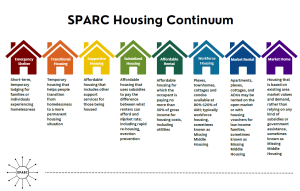
This concept became foundational to how we think about housing and services today through the SPARC Model.
Building Structure: Shelter and Transitional Models
As the work expanded, the focus shifted toward addressing unsheltered homelessness through structured environments.
This included the development of:
- Pallet shelter communities
- Managed campgrounds
- Transitional village models
- Congregate shelters and navigation centers
These approaches created safer, more stable environments and established clear entry points into services.
Many of these models were successfully implemented and replicated across Southern Oregon and into neighboring regions.
However, even with improved shelter capacity, a consistent challenge remained:
Individuals often struggled to transition from shelter into permanent housing.
The Turning Point: From Programs to Systems
Over time, it became clear that the challenge was not simply the availability of programs—but the lack of coordination between them.
Outreach, shelter, housing, and services existed, but often operated independently.
This fragmentation created gaps in the system—gaps where individuals could lose connection and remain unhoused.
This realization led to a shift in focus:
From improving individual programs…
to building systems that function as a whole.
Where the Work Is Today
Today, that approach is reflected in the work of the North Bend City / Coos-Curry Housing Authorities and our regional partners.
Key components include:
- North Bend Family Housing — the first large-scale affordable housing development in the region in over 40 years
- Anchor Point Housing — the first Housing Authority development in Curry County in over 40 years
- Regional system coordination across outreach, shelter, housing, and services
- Development of the SPARC Model through Southern Oregon Coast Regional Housing (SOCRH), Brookings CORE Response (BCR), and the South Coast SPARC Network
The goal is straightforward:
To ensure that individuals can move from crisis to stability through a connected and coordinated system.
Why This Matters for Rural Communities
In rural communities, resources are limited.
There is little capacity for duplication, and fragmented systems create immediate challenges:
- Longer durations of homelessness
- Inefficient use of limited resources
- Reduced confidence in available solutions
When systems are aligned, the opposite occurs:
- Individuals move more effectively toward housing
- Resources are used more efficiently
- Communities see measurable progress
Documenting and Sharing the Work
As this work has evolved, we have made a deliberate effort to document and share lessons learned:
- NBC/CCHA Blog: https://ccnbchas.org/blog/
- Homeless Solutions Consultants: https://www.homelesssolutionsconsultants.com/blog
- SPARC in Rural California (Del Norte Mission Possible):
https://delnortemissionpossible.org/news-1/f/building-what%E2%80%99s-been-missing-sparc-in-coos-and-curry-counties - SPARC Network (SOCRH): https://www.sparcnetwork.org/
These resources reflect ongoing efforts to build and refine a coordinated approach.
Video & Media Coverage
A timeline of this work can be viewed through the following:
🎥 Early Work & Foundation
https://www.youtube.com/watch?v=NTCs5ptMbQ8
https://www.youtube.com/watch?v=jQPvEiXGQ50
https://www.youtube.com/watch?v=oFefU4eRlXo
https://youtu.be/wNz__3_jQMk?si=VleBUvBqi4EHNsKa
🏗️ Transition to Housing
https://www.youtube.com/watch?v=_A1dCINdE-4
https://www.youtube.com/watch?v=M9DkZhEHzxc&t=1s
🏕️ Shelter & Transitional Models
https://www.youtube.com/watch?v=8zApMEBn9EI
https://youtu.be/ltPXr0_HW8I?si=ddhFhwSeTGF4uyOg
📰 Media Coverage Highlights
https://clubhouse-intl.org/the-compass-house-story/
https://www.streetroots.org/housing/2021/04/28/anti-camping-law-medford-draws-national-attention/
https://kobi5.com/news/local-news/rogue-retreats-gateway-housing-in-talent-close-to-filling-up-for-almeda-fire-survivors-181437/
https://bendbulletin.com/2021/08/29/oregons-low-barrier-shelters-can-offer-entry-into-services/
https://www.nrtoday.com/news/local/much-needed-to-help-homeless-people-in-roseburg-medford-group-says/article_6c157721-b535-5bac-8827-f16d434623ab.html
https://kobi5.com/news/north-bend-family-housing-project-includes-105-affordable-housing-units-267146/
https://theworldlink.com/news/low-income-housing-development-breaks-ground-first-of-its-kind-in-40-years/article_979c2a66-e38d-4b19-9083-dec7d99ff94c.html
https://ktvl.com/station/news-10-first-alert-fire-recovery/new-pallet-shelters-increase-housing-options-at-rogue-retreat-urban-campground
https://wildrivers.lostcoastoutpost.com/2019/oct/8/rogue-retreat-introduces-tiny-house-transitional-h/
https://www.kdrv.com/community/medford-city-council-approves-rogue-retreat-s-new-urban-campground-location/article_acfc6070-ee9e-11ec-8412-c72f7a619db6.html
https://www.opb.org/article/2020/08/18/medfords-first-urban-campground-provides-a-safe-space-for-homeless-campers-but-not-for-long/
https://ktvl.com/news/local/grants-pass-to-see-newly-proposed-transitional-homes-for-homeless-after-success-in-medford
Closing: A System Taking Shape
This body of work reflects more than a series of individual projects.
It reflects an evolution in how we approach housing and services.
What began as responses to immediate needs—shelter, safety, and stability—has developed into a broader understanding:
Lasting solutions require connected systems.
Today, our focus is not only on building housing, but on ensuring that housing is part of a coordinated pathway that supports long-term stability.
For many communities, the necessary components already exist.
The opportunity—and the work ahead—is to align those components into a system that functions.
Because when systems work together:
- People move forward
- Communities stabilize
- Progress becomes sustainable
Matthew Vorderstrasse
Executive Director
North Bend City / Coos-Curry Housing Authorities