
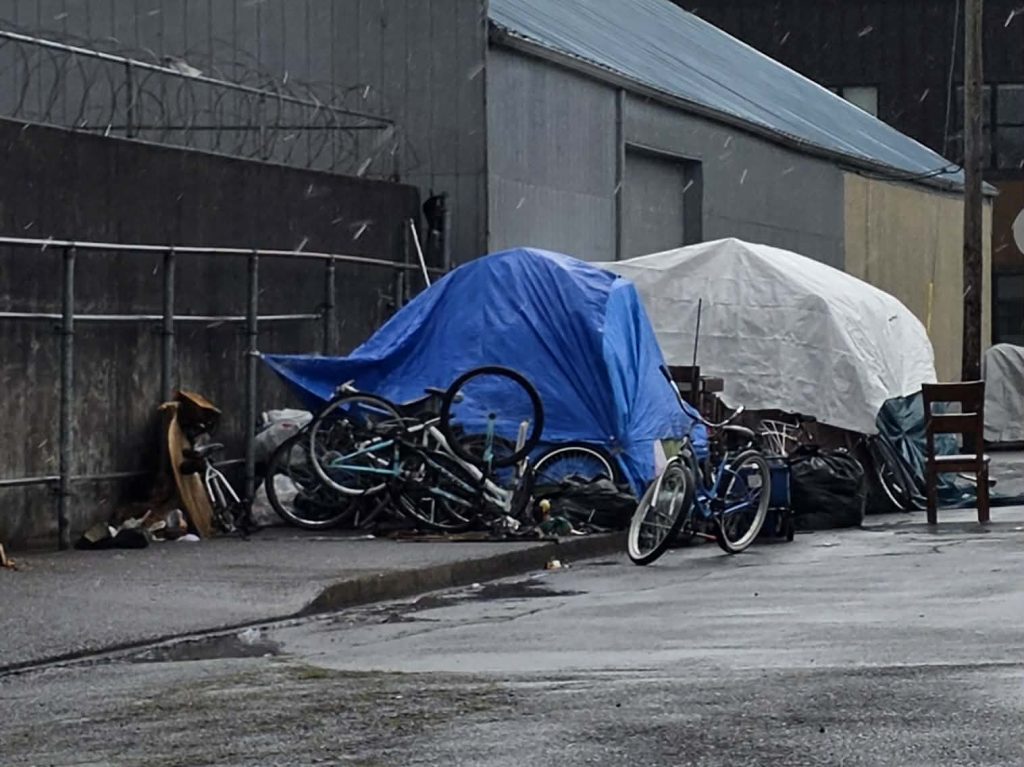
During a recent visit to Astoria, Oregon, one thing became immediately clear: homelessness in rural communities is becoming increasingly visible — not necessarily because the number of people experiencing homelessness is dramatically larger than in urban areas, but because local ordinances and enforcement patterns are concentrating unsheltered individuals into very specific areas of a community.
Industrial corridors, waterfront edges, alleyways, and commercial buffer zones are increasingly becoming unofficial containment areas for people with nowhere else to go.
This is not unique to Astoria.
Communities across rural Oregon are wrestling with the same challenge. As camping restrictions, public space ordinances, and enforcement activities increase, individuals experiencing homelessness are often displaced from one location to another without meaningful exits from homelessness being created in parallel.
When shelter capacity, outreach infrastructure, behavioral health support, navigation services, and affordable housing pathways are insufficient, people do not disappear. They simply become more concentrated and more visible.
In smaller rural communities, that concentration can quickly create tension between businesses, residents, local governments, and vulnerable individuals struggling to survive outdoors.
The Challenge Rural Communities Face
Rural homelessness presents unique challenges that differ significantly from larger metropolitan systems:
Limited shelter capacity
Severe affordable housing shortages
Geographic isolation
Transportation barriers
Workforce shortages
Limited behavioral health infrastructure
Fragmented service systems
Smaller local government capacity
At the same time, rural communities often lack the resources necessary to build fully coordinated systems on their own.
As a result, many communities find themselves trapped in reactive cycles: encampment growth, enforcement, displacement, public frustration, and repeated crisis response — without enough long-term housing exits being created.
Why the SPARC Model Was Created
This is one of the core reasons the SPARC Model was developed.
SPARC, which stands for Service Providers and Regional Connections, is a regional systems framework designed to help rural communities move beyond fragmented responses and begin building coordinated systems of care
The model focuses on aligning:
Housing development
Shelter systems
Coordinated Entry
Street outreach
Behavioral health services
Healthcare partnerships
Workforce pathways
Navigation and case management
Local governments and nonprofits
Rather than organizations operating independently in silos, SPARC seeks to create integrated pathways that move people from crisis toward long-term stability.
The goal is not to normalize encampments. The goal is not endless emergency response. The goal is not moving people block by block around a community.
The goal is to create real pathways:
Street Outreach → Shelter → Stabilization → Housing → Long-Term Success
A Systems Problem Requires a Systems Solution
Homelessness is often discussed as though it is solely an individual issue. In reality, what communities are increasingly witnessing is a systems-capacity issue becoming physically visible in public space.
When communities do not have enough housing inventory, shelter beds, supportive services, behavioral health infrastructure, or coordinated navigation systems, those failures eventually become visible on sidewalks, under bridges, along waterfronts, and in industrial corridors.
Enforcement alone cannot solve that reality.
Long-term solutions require:
More housing production
Permanent Supportive Housing (PSH)
Regional coordination
Behavioral health partnerships
Strong outreach systems
Sustainable shelter infrastructure
Workforce and economic mobility pathways
Collaborative public-private partnerships
Building a Better Path Forward
At the North Bend City / Coos-Curry Housing Authorities and through our partnership with Southern Oregon Coast Regional Housing (SOCRH), we believe rural communities deserve systems that create exits from homelessness — not simply systems that relocate visible poverty.
The SPARC framework was built with this belief at its core.
Rural Oregon communities are resilient, collaborative, and innovative. With the right partnerships and coordinated investments, we believe it is possible to build systems that reduce homelessness while also strengthening the long-term health, safety, and stability of our communities.
The future of rural homelessness response must move beyond reaction and toward coordination, housing creation, and systems-building.
That is the future SPARC is working to help build.
By Matthew Vorderstrasse, M.A., PHM