
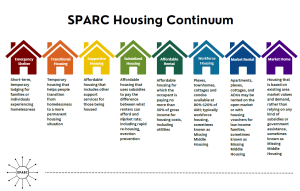
SPARC—Service Providers and Regional Connections—is a regional systems framework designed to align outreach, shelter, housing, and services so people can move out of homelessness in a way that actually holds. At the macro level, SPARC is not a program or a ladder. It is a coordination model focused on how systems connect, where they break down, and what is required to keep people housed once they exit crisis.
One of the most critical—and most misunderstood—components of that system is Permanent Supportive Housing (PSH).
The Problem PSH Is Designed to Solve
In most homelessness systems, the greatest failure point sits between shelter and housing.
Shelter stabilizes people. Affordable housing expects stability. For individuals with serious mental illness, chronic health conditions, long histories of trauma, or repeated episodes of homelessness, that jump is often too large.
Without an intentional bridge:
-
Shelter beds remain occupied by people who cannot safely exit
-
Transitional housing becomes a holding pattern
-
Affordable housing providers inherit crises they are not resourced to manage
-
People cycle back into emergency systems
PSH exists to prevent that failure.
The PHA Context: Serving High-Need Households With Limited Tools
Public Housing Authorities have historically served many of the most vulnerable households in our communities—people with extremely low incomes, disabilities, complex health needs, and limited housing options. That work has always mattered. But it has not always produced consistent results.
For decades, PHAs and other housing providers were asked to house high-need populations without reliable access to supportive services. Some households stabilized and thrived. Others struggled in environments that were never designed to carry the level of support they required. Too often, housing alone was expected to resolve challenges rooted in trauma, disability, or chronic illness.
This context matters.
SPARC does not change who is being served. It expands how support is structured around the people housing providers are already serving.
What PSH Does Inside SPARC
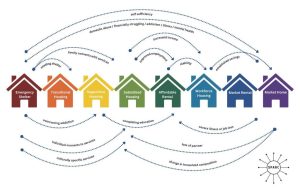
Within SPARC, PSH is not the backbone of the system. It is the structural bridge that reaches up from shelter and transitional housing and connects people into affordable housing with services intact.
PSH:
-
Creates viable exits from shelter for high-acuity individuals
-
Extends stabilization into permanent housing
-
Carries services across the point where systems usually disconnect
-
Protects both shelter capacity and housing stability
This is not about permanence for its own sake. It is about preventing system collapse at its most fragile point.
PSH Is Not for Everyone—and That’s the Point
SPARC treats PSH as a targeted systems tool, not a default placement.
PSH is reserved for people who cannot maintain housing stability without ongoing support. When used correctly:
-
Shelter can return to its core function—short-term stabilization
-
Transitional housing can remain time-limited and purposeful
-
Affordable housing can serve a broader population successfully
When PSH is overused or misapplied, systems distort.
When PSH is underbuilt, systems clog.
Balance is not optional—it is required.
Finding the Balance: Blended and Supported Housing in Practice
Within SPARC, balance is not theoretical—it is being built intentionally through blended and supported housing models.
Across our housing portfolio, developments are being designed to include PSH components alongside deeply affordable and workforce rental housing, rather than isolating supportive housing into single-purpose sites. This allows high-acuity needs to be met without redefining entire properties around service intensity.
This approach is not PHA-specific. Any housing provider—nonprofit or private—can build and operate blended housing when capital, operating, and service partnerships are aligned. The value of this approach is not who builds it, but how it is designed.
By integrating PSH units into broader housing developments:
-
Supportive services remain targeted, not universal
-
Housing stability improves for residents with higher needs
-
Property operations remain viable and predictable
-
Communities experience integration rather than concentration
These models allow PSH to function as a precision tool, not a blanket solution.
Carrying Services Across the Housing Line
One of the most important roles PSH plays in SPARC is that services do not end when housing begins.
Shelter-based services are often tied to beds. Affordable housing often assumes independence. PSH ensures continuity—behavioral health care, peer support, case management, and healthcare coordination continue through the transition into permanent housing.
Within SPARC, services follow the person—not the building.
This continuity is what turns a housing placement into housing stability.
Why PSH Relieves Pressure Across the System
When PSH is integrated properly:
-
High-acuity shelter guests can exit safely
-
Shelter lengths of stay decrease
-
Outreach teams have realistic placement options
-
Emergency rooms and jails see reduced utilization
PSH does not slow systems down.
It absorbs pressure so other parts of the continuum can function as designed.
How This Shows Up Locally: Expressing the SPARC Model in Practice
Locally, this is not theory—it is how the SPARC model is being expressed on the ground.
In our region, PSH is being planned and implemented as a systems connector, not a standalone solution. Shelter, transitional housing, and outreach are designed with clear exits in mind. Affordable housing is being developed with the understanding that some households will require ongoing support to succeed. Services are structured to follow people across transitions rather than reset at every door.
Rather than concentrating PSH into isolated projects, we are integrating supported units within broader affordable housing developments, calibrating service intensity to individual need, and coordinating closely with service partners to ensure continuity. This allows PSH to do its job—bridging shelter to housing—without overwhelming properties, programs, or neighborhoods.
This is what SPARC looks like when it is applied locally:
-
Shelter that is designed to move, not warehouse
-
Housing that is built to hold, not cycle
-
Services that stay connected through transition
-
PSH that absorbs pressure so the rest of the system can function
The result is not a single project or program. It is a regional system that can flex, respond to real people with real needs, and remain stable over time.
The Bottom Line
SPARC works when the connections hold.
Permanent Supportive Housing is one of those connections. It reaches from shelter and transitional housing into affordable housing and carries services across the gap where people are most likely to fall.
PSH is not the headline of SPARC.
But without it, the system fractures where it matters most.
That is why PSH is not optional.
It is structural.
By
Matthew Vorderstrasse, M.A., PHM.