
SPARC does not begin with building new programs.
It begins with asking better questions.
Communities often assume that transformation requires new funding, new structures, or new initiatives. In reality, most systems already have the core components in place. What is missing is intentional connection.
SPARC provides a framework for understanding how your existing system functions—and where it breaks down—so it can be redesigned for movement.
This is not a checklist.
It is a way of thinking.
Step 1: Map Your System
Begin by mapping how your current system actually operates.
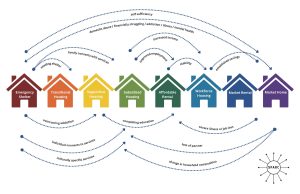
Identify how outreach, shelter, housing, services, workforce development, education, and ownership pathways connect today. Not how they are intended to connect—but how they function in practice.
Where does movement slow or stop?
Where do handoffs fail?
Where do people fall out of the system entirely?
Most communities already know the answers. SPARC simply gives you permission to name them.
Step 2: Identify Bottlenecks
Once the system is mapped, bottlenecks become visible.
Common pressure points include:
-
Shelter exits that rely on too few housing options
-
Permanent Supportive Housing lease-up delays
-
Service engagement that does not translate into housing readiness
-
Income and employment gains that still leave people unable to move forward
-
Ownership pathways that are introduced too late—or not at all
Bottlenecks are not failures.
They are signals.
SPARC treats bottlenecks as design problems, not performance problems.
Step 3: Name the Backbone Function
Every functioning system has someone holding the map.
SPARC requires a clearly identified backbone function—an entity or role responsible for alignment, continuity, and adaptation across the continuum.
This function does not manage programs.
It does not replace existing organizations.
It ensures that the system remains coherent as conditions change.
If no one owns alignment, fragmentation will.
Step 4: Strengthen Coordinated Entry
In a SPARC system, Coordinated Entry is more than a list.
It informs prioritization.
It prepares households for placement.
It connects outreach, shelter, housing, and services into a single operating picture.
When Coordinated Entry becomes performative, systems fragment.
When it is protected and resourced, systems stabilize.
SPARC treats Coordinated Entry as infrastructure, not compliance.
Step 5: Align Services to Movement
Services are essential—but only when they support transitions.
SPARC clarifies how service providers, workforce partners, and education institutions support movement through the system rather than operating in isolation.
Providers are not interchangeable.
They are not meant to compensate for missing housing or broken exits.
When services are asked to hold people in place, the system is out of balance.
SPARC restores clarity and boundaries.
Step 6: Build Ownership Pathways Early
A housing system that ends at renting is incomplete.
SPARC systems include credible ownership pathways through Community Land Trusts, first-time homebuyer programs, shared equity models, or other community-appropriate tools.
Ownership preparation should begin years before a home is available.
Ownership is not mandatory for everyone.
Access to it must be real.
Without ownership pathways, systems stagnate.
Step 7: Establish Governance That Protects Flow
SPARC governance exists to protect the system, not manage programs.
Effective governance:
-
Surfaces reality
-
Uses shared data to guide decisions
-
Protects system flow
-
Adapts as conditions change
Local planning groups manage local implementation.
Regional coordination protects coherence.
When governance lacks clarity, power drifts and trust erodes.
Built Intentionally, Not All at Once
SPARC is not implemented overnight.
It is built intentionally, piece by piece, with a shared understanding of where the system is going and why each component exists.
Communities do not need to copy another region’s structure.
They need to understand their own system—and design it to move.
That is how SPARC begins.
By Matthew Vorderstrasse, M.A., PHM
Executive Director, North Bend City & Coos-Curry Housing Authorities