
Across the country, communities are investing significant resources into addressing homelessness. Outreach expands. Shelters open. Housing is developed. Services increase.
And yet, many systems remain stalled.
The issue is rarely a lack of effort or care.
It is the absence of a shared operating model.
The SPARC Model was created to address that gap.
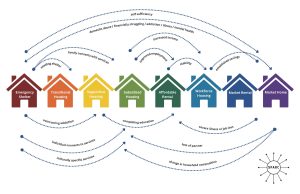
SPARC is not a program, a funding stream, or a single organization. It is an operating model designed to align outreach, shelter, housing, services, rental assistance, and ownership pathways into a functioning continuum that moves people forward.
This blog defines the SPARC Model, outlines its foundational standards, and describes how it is being designed and implemented on Oregon’s South Coast, where the model was formed.
Why Systems Stall Even When Programs Exist
Many homelessness response systems struggle not because programs are ineffective, but because they operate in parallel rather than in coordination.
Outreach engages people, but shelter is full.
Shelter stabilizes people, but housing exits are limited.
Housing exists, but services are disconnected.
Services exist, but pathways forward are unclear.
Each component works hard.
The system as a whole does not move.
SPARC begins with a different assumption: housing systems must be intentionally designed for flow.
Rather than replacing existing programs, SPARC provides a shared framework for how systems behave—so that movement through the continuum is expected, supported, and sustained.
SPARC Is an Operating Model, Not a Program
SPARC defines how systems connect, not how individual programs are run.
It does not prescribe:
-
staffing models
-
governance structures
-
funding sources
-
organizational control
Instead, it establishes standards that ensure outreach, shelter, housing, services, and ownership pathways are functionally integrated.
Communities may implement SPARC in different ways.
They may not ignore its core standards.
The Standards of the SPARC Model
For SPARC to function, certain standards must be present. These standards define how systems behave, not how organizations are structured.
-
The Standard of Flow
Every component of the housing continuum must lead somewhere. Outreach leads to shelter or housing. Shelter leads to housing. Housing leads to stability and opportunity. Ownership is possible. Systems are designed for movement, not parking. -
The Standard of Functional Integration
Programs do not exist in isolation. Housing, health care, behavioral health, substance use treatment, workforce development, and education are intentionally connected. Referrals alone are not integration. -
The Standard of Coordinated Entry Integrity
Coordinated Entry functions as infrastructure, not compliance. It informs prioritization, prepares households for placement, and connects outreach, shelter, housing, and services into a single operating picture. -
The Standard of a Backbone Function
Every SPARC system includes a backbone function responsible for alignment, adaptation, and continuity. This function supports programs, monitors bottlenecks, and helps systems adjust before crisis becomes collapse. -
The Standard of Housing as Health Infrastructure
Housing is treated as foundational to health. Permanent Supportive Housing aligns with outreach and Coordinated Entry. Shelter is designed for stabilization. Medical respite bridges health and housing. -
The Standard of Service, Workforce, and Education Alignment
Service providers, workforce partners, and education institutions each serve distinct roles. When providers are asked to compensate for missing housing or broken exits, the system is out of balance. -
The Standard of Ownership Pathways
A system that ends at renting is incomplete. SPARC includes credible pathways to ownership through Community Land Trusts, shared equity, or other community-appropriate tools. -
The Standard of Governance Through Shared Data and Policy Alignment
SPARC providers operate with consistent data practices, Coordinated Entry standards, and shared policy expectations. Local implementation varies, but system integrity is protected. -
The Standard of Adaptation Without Dilution
SPARC is designed to be adapted across rural and urban contexts. Core functions remain consistent even as structures vary. -
The Standard of Shared Ownership of the Work
SPARC does not belong to one organization. Responsibility, outcomes, and accountability are shared across the system. -
The Standard of Dignity
People experiencing homelessness are not problems to be managed. Providers are not resources to be exhausted. Dignity is the baseline. -
The Standard of Shared Learning and Replication
SPARC is designed to be shared with other communities. Learning is documented, refined, and taught so systems can improve collectively.
Managing Partners and System Roles on the South Coast
SPARC is implemented locally through managing partners, with defined roles that support county-specific implementation and regional alignment.
On Oregon’s South Coast:
-
Southern Oregon Coast Regional Housing (SOCRH) manages SPARC in Coos County
-
Brookings CORE manages SPARC in Curry County
Both organizations have applied to serve as county shelter coordinators, aligning shelter operations with Coordinated Entry, housing exits, and system planning.
In addition:
-
SOCRH provides Community Land Trust (CLT) and technical assistance support in Curry County.
-
Brookings CORE supports SPARC-wide data and Coordinated Entry training in Coos County.
Each county manages its own allocations and priorities. Shared data practices and standards protect system coherence.
The Role of Affordable Housing Providers
Within SPARC, affordable housing providers play a critical system role: creating housing that enables flow.
This role may be carried by a Public Housing Authority, nonprofit developer, mission-driven private developer, or a combination of partners. What matters is the function, not the entity.
Housing providers within SPARC:
-
Align development with Coordinated Entry
-
Include Permanent Supportive Housing where needed
-
Embed services through partnerships
-
Create exits from shelter that reduce system pressure
Housing is treated as system infrastructure, not a standalone project.
How This Is Being Implemented on Oregon’s South Coast
On the South Coast, this function is currently being carried by the local Public Housing Authority in partnership with service providers and SPARC managing partners.
In Coos County, North Bend Family Housing is being developed with Permanent Supportive Housing units aligned to Coordinated Entry and embedded services that support exits from shelter.
In Curry County, Ellensburg Housing is being developed to expand affordable housing supply while supporting system movement at a scale appropriate to the community.
In both cases, housing is being developed in coordination with the system, not downstream from it.
Other communities may assign this role differently. SPARC does not require a PHA-led model.
The South Coast as the Founding Expression of SPARC
The South Coast is not the model itself.
It is the region where SPARC was formed, and it represents one expression of how the model can be designed and implemented.
SPARC was developed on Oregon’s South Coast in response to real system pressure, real housing constraints, and the need to connect outreach, shelter, housing, services, and ownership into a single, functioning continuum.
Other communities adopting SPARC will design systems that fit their own context. That variation is expected.
What must remain consistent are the standards.
When the standards hold, systems move.
When systems move, people move.
And that is how homelessness ends.
By Matthew Vorderstrasse, M.A., PHM
Executive Director, North Bend City & Coos-Curry Housing Authorities